Smart Health Tech Deals

Buy Oura if sleep, recovery and cycle tracking matter most and you want a week of battery on a ring you can wear anywhere. Buy Whoop if you train hard and want strain scores and workout coaching. If you mainly want to watch body composition change, skip both and buy a smart scale.
We get asked about these two constantly, because they share a philosophy. Neither has a screen, neither nags you to close rings, and both are built around sleep and recovery rather than notifications.
The difference is what they were designed to answer. Oura answers “how rested am I?” Whoop answers “how hard did I go, and can I go again?”
All prices below are US list prices as of August 2026.
Oura vs Whoop: what does each one actually cost?
This is where most comparisons go wrong, because the two use opposite business models. Oura sells you hardware and then charges a small membership. Whoop charges a membership and includes the hardware.
| Option | Upfront | Ongoing | Best at | What you give up | Who it suits |
|---|---|---|---|---|---|
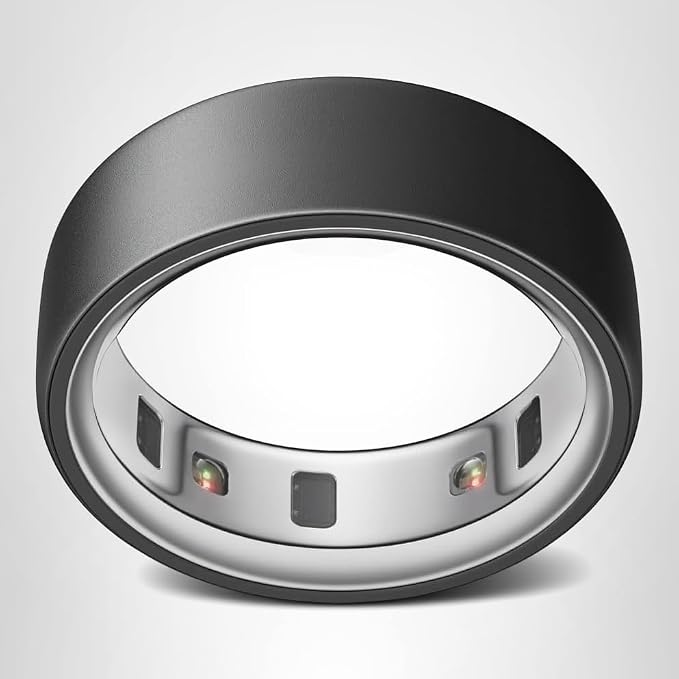
| Oura Ring 4 | From $349 (up to $499 for gold, rose gold or ceramic finishes) | $5.99/mo or $69.99/yr, first month free | Sleep, readiness, temperature trends, cycle insights | Detailed workout intensity; you cannot lift heavy in it comfortably | Sleep-focused adults who want jewelry, not a gadget |
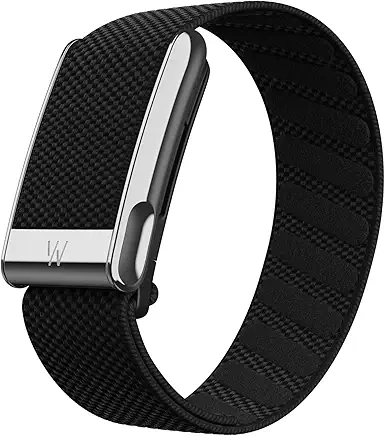
| Whoop One | $0 | $199/yr | Strain, recovery and sleep coaching on a budget | The wireless PowerPack and the fancier band | Anyone trying Whoop for the first time |
| Whoop Peak | $0 | $239/yr | The mainstream Whoop experience with health monitoring | ECG and blood pressure features | Regular gym-goers and endurance athletes |
| Whoop Life | $0 | $359/yr | MG hardware with ECG and on-demand AFib detection | The most expensive tier by a wide margin | People tracking cardiovascular health closely |
| Smart body composition scale | Roughly $30 to $90 | $0 | Weight and body composition trends over months | Sleep, HRV, recovery, everything wearable | Anyone whose actual goal is body composition |
Over three years, an Oura Ring 4 at $349 plus annual membership lands near $559. Whoop One over the same period is about $597, Peak about $717.
So Oura is not the cheap option in our math. It is the option where you own something at the end.
Which is better for sleep tracking, Oura or Whoop?
Oura, and in our reading of the specs it is not close. A ring sits on a finger where the arteries are close to the surface and where movement artifacts are lower than at the wrist.
Oura also does the softer parts well. Readiness scores, temperature deviation from your own baseline, and cycle insights are presented in a way that a non-athlete actually acts on.
Whoop tracks sleep competently and its sleep coach is good at telling you when to go to bed to hit a performance target. But if you are buying primarily to fix your sleep, buy the ring.
Which is better for training and workouts?
Whoop. Its whole model is a daily strain score set against a recovery score, and the coaching is built to answer whether today should be hard or easy.
Whoop also survives training in a way a ring does not. Barbells, kettlebells and climbing holds are hard on a titanium ring, and plenty of people end up taking Oura off for exactly the sessions they most wanted to measure. Whoop’s band can also be worn on the bicep.
If you lift, cycle or run seriously and want the tracker on your body during the effort, that alone decides it.
How do the subscriptions actually work?
Oura’s membership is $5.99 a month or $69.99 a year, with the first month free. Without it, the ring keeps showing basic scores but you lose the detailed insights, trends and most of what you paid for.
Whoop has no hardware charge. One is $199/yr, Peak is $239/yr and Life is $359/yr. Monthly billing exists at $25, $30 and $40 but Whoop restricts it to existing members and it still carries a 12-month commitment, so new members are effectively signing up for a year.
The honest downside on both sides: stop paying Whoop and you have nothing, because the hardware goes back. Stop paying Oura and you still own a titanium ring, just a much less interesting one.
Which has better battery life?
Whoop 5.0 is rated at 14+ days and charges with a slide-on pack you can wear while it charges, so the device never leaves your wrist.
Oura Ring 4 is rated up to 8 days depending on size and features, and it charges on a small dock in 20 to 80 minutes. That means a gap in your data unless you charge it in the shower or while cooking.
Both are far better than a smartwatch. Whoop’s continuous-wear charging is the more elegant solution.
What do these trackers measure reliably, and what is just directional?
Reasonably reliable on both: resting heart rate, heart rate variability, respiratory rate, total sleep time and long-run trends in all of them. These are the numbers worth acting on.
Directional at best: sleep stage breakdowns, calorie burn, and any single-day score. Consumer wearables infer stages from movement and heart rate rather than brain activity, so treat a nightly REM figure as a rough estimate.
Body temperature is relative, not clinical. Both track deviation from your own baseline, which is genuinely useful for spotting illness or cycle phase, and useless as a thermometer.
Whoop’s Blood Pressure Insights deserves a specific flag. The feature drew an FDA warning letter in July 2025, which the agency later closed. It is positioned as a wellness estimate, requires a cuff calibration, and is not a diagnosis. Do not manage hypertension with it.
How do you get the sizing right?
Oura ships a free plastic sizing kit and asks you to wear it for a full day and night before ordering. Do it. Fingers swell with heat, salt and exercise, and Oura’s sizes do not map neatly onto jewelry sizes.
Most people wear it on the index finger rather than the ring finger, and the sensors need consistent skin contact to work, so a slightly loose fit costs you accuracy.
Whoop sizing is simpler. You pick a band length, and if the wrist bothers you during lifting, the bicep sleeve is a real option.
Who should skip both and buy a smart scale instead?
If your goal is written as a weight or a body fat percentage, neither tracker measures it. A bioimpedance smart scale, generally $30 to $90, does, and there is no subscription.
Be realistic about accuracy. Bioimpedance readings shift with hydration, food, and time of day, and they will not match a DEXA scan. What they do well is show a trend line if you weigh yourself at the same time each morning.
For a lot of households in our audience, the sensible stack is a $40 scale plus the sleep habits you already know you should fix, and no subscription at all.
Shop the picks
Track your sleep, recovery, body composition, and overall wellness with the best Prime Day discounts on leading smart health devices. Find the best best Smart Health Tech Deals.
Shop all smart tech devices on sale.
Some links on this page are affiliate links. If you buy through them we may earn a commission, at no extra cost to you. It never changes what we recommend.
Oura Ring 4
Whoop 5.0
Smart Scale
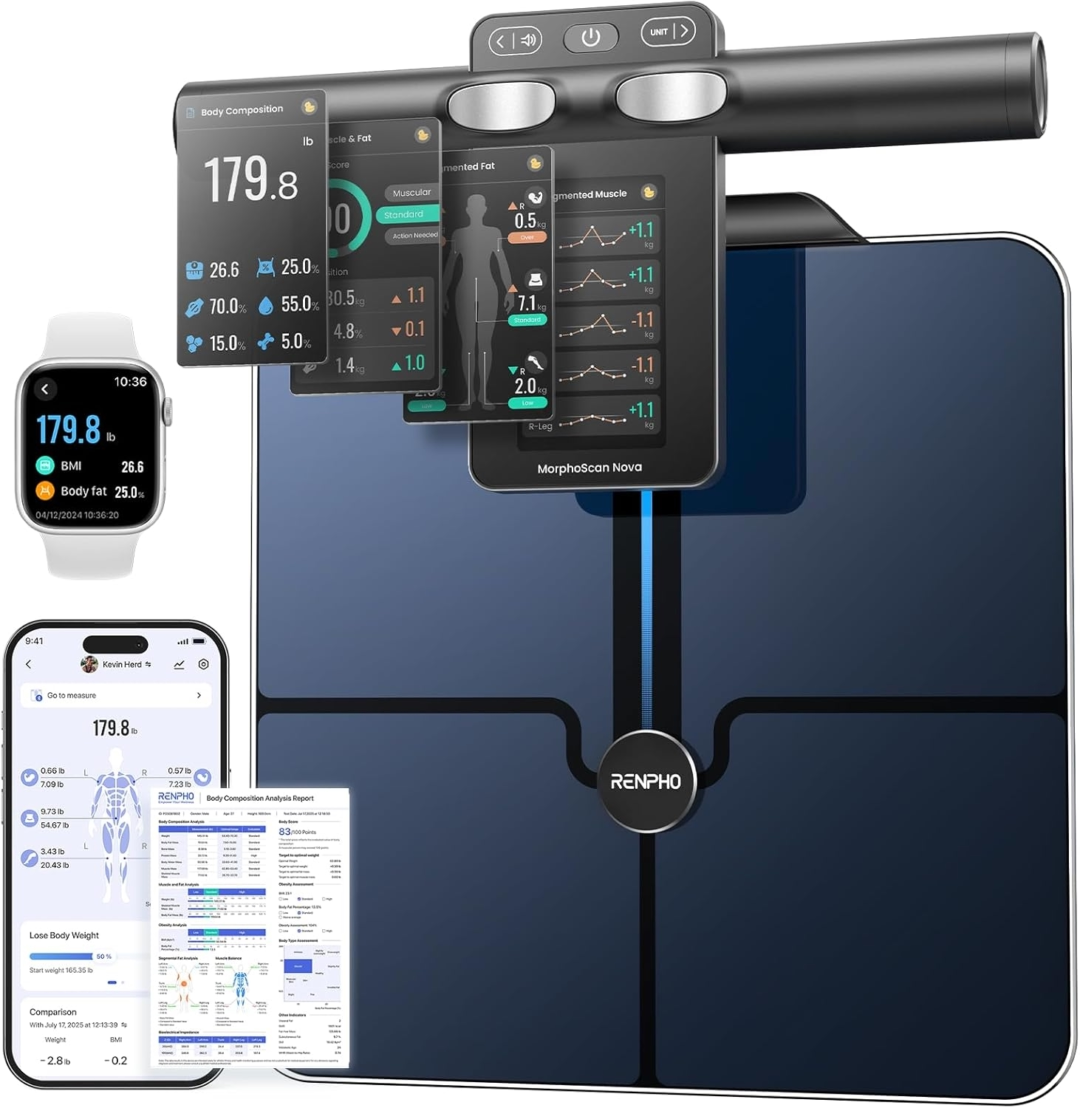
Also checkout Other Renpho scale
Frequently asked questions
Can you use an Oura Ring without the subscription?
Yes, but it becomes a much simpler device. You keep basic daily scores and lose the detailed sleep, readiness and trend analysis that most of the value sits in. Since the membership is $69.99 a year, most owners keep it.
Is Whoop worth it if you are not an athlete?
Usually not. Whoop’s strain and recovery framing is built for people who train with intent, and if you walk the dog and lift twice a week, you are paying $199 to $359 a year for coaching you will not use. Oura or a scale makes more sense.
Can you wear an Oura Ring while lifting weights?
You can, but titanium scratches and knurled barbells are unkind to it. Many owners take it off for lifting, which puts a hole in exactly the workout data they wanted. If that describes you, Whoop is the better fit.
Do Oura and Whoop track menstrual cycles?
Both offer cycle features, and Oura’s are more developed, using temperature deviation to predict phases and flag shifts. Neither is contraception and neither replaces a doctor. Treat the predictions as a helpful pattern, not a guarantee.
Which one is more accurate for heart rate variability?
Both are credible, and they measure at different times, so their numbers will not match each other. Oura samples largely overnight; Whoop samples continuously. What matters is watching your own trend on one device rather than comparing across two.
Can you buy Whoop hardware outright without a membership?
No. The hardware comes with the membership and goes back when you stop. That is the trade for the $0 upfront price, and it is the single biggest structural difference between the two products.